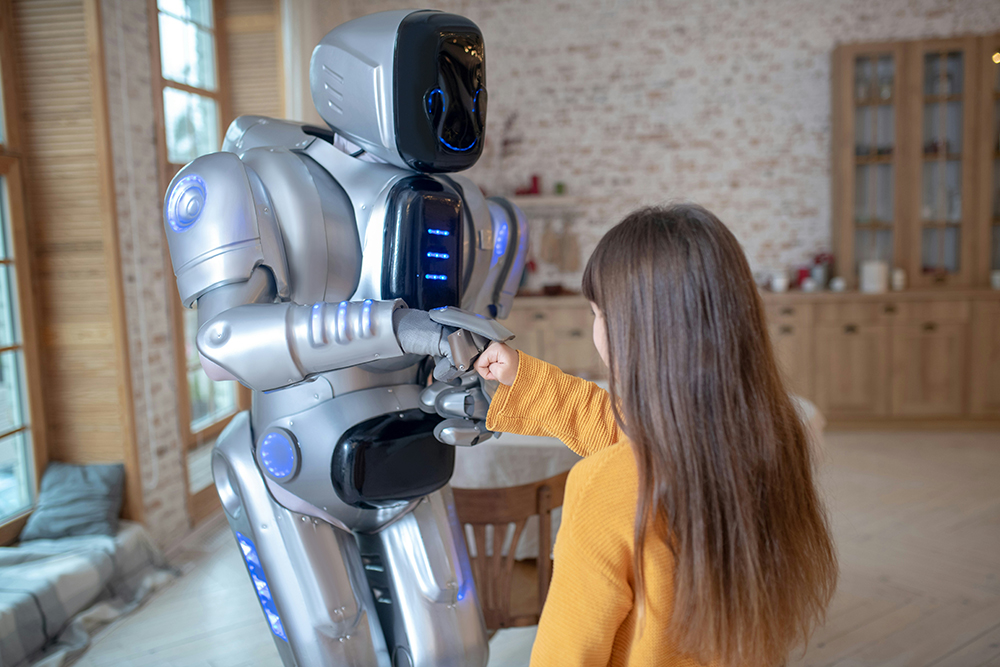
Norwegian company 1X sold out all ten thousand units of NEO, its home humanoid robot, in just five days, even though the machine costs $20,000 and depends on human operators who control it from a distance. The scene captures the moment this industry is living through: the enthusiasm of investors and buyers far outstrips the real capabilities of machines that still cannot handle the basic chores of a house.
A Promise That Sells Out Preorders
By: Gabriel E. Levy B.
Humanoid robot makers are enjoying their best commercial moment. Research firm Omdia calculates that worldwide shipments passed 13,300 units in 2025, nearly six times the previous year’s figure. Capital followed the euphoria: venture funds poured $6.1 billion into the sector in 2025 alone, according to MIT Technology Review, and American startup Figure reached a valuation of $39 billion after a round that exceeded $1 billion. Giants like Boston Dynamics and dozens of Chinese companies are chasing the same prize. Elon Musk promises that Tesla will sell its Optimus robot to the public around 2027 for a price between $20,000 and $30,000. Norway’s 1X is already shipping its NEO model to the first buyers, while Figure tests its humanoid in selected homes across the United States. If the announcements hold, thousands of households will live with these machines before the decade ends. The problem appears when we read the fine print of what they can actually do.
Dexterity That Isn’t There Yet
Real capabilities fall far short of the marketing. When TIME magazine visited Figure’s labs in 2025, the robot failed twice in a row while trying to load a washing machine and folded towels with obvious clumsiness. Musk himself acknowledged in January 2026 that no Optimus was doing useful work in Tesla’s factories. Boston Dynamics admitted that the demonstration of its new Atlas at CES 2026 was controlled by operators. 1X’s NEO performs only elementary tasks on its own, such as fetching objects or turning off lights, and hands the rest to teleoperators, people who steer it from a distance with virtual reality headsets from the company’s offices. The new vision, language and action models, artificial intelligence systems that translate what the machine perceives into physical movements, improved overall coordination, though they keep failing when situations turn unpredictable. Veteran roboticist Rodney Brooks, cofounder of the company that created the Roomba vacuum, points out that the human hand holds some 17,000 touch sensors and warns that no current database can replicate that sensitivity. His forecast is harsh: robotic dexterity will remain poor beyond 2036.
Numbers That Don’t Add Up
The economics offer no relief either. Tesla aims to sell Optimus for less than $30,000, yet analysts calculate that building one costs between $50,000 and $100,000 today. Bank of America estimates that the materials for an average humanoid are worth about $35,000 and would only drop to $17,000 by 2030 if production concentrates in China. Actuators, the motors that move each joint, account for up to half of that cost. The hidden expense of teleoperation joins the list: an independent analysis calculated that 1X’s subscription scheme loses money if each robot demands more than 49 minutes of human assistance per day. Against prices this high, renting with a monthly fee, known as leasing, emerges as the most viable financial model. 1X offers its NEO for $499 a month and Figure is weighing fees between $400 and $600. Leasing lowers the entry barrier and leaves maintenance in the manufacturer’s hands, which can also update the equipment without demanding a new purchase.
China Runs Ahead
While the West shows off expensive prototypes, China manufactures at volume. Firms AgiBot and Unitree shipped more than 9,000 humanoids together in 2025, close to 70 percent of the world market. The average price of these machines in China fell from 593,400 yuan in 2023 to 167,600 in 2025, and Unitree’s R1 model sells from the equivalent of about $5,600. The Chinese government declared embodied intelligence, the branch that joins artificial intelligence with physical bodies, a priority of its new five-year plan and created public funds worth more than $14 billion to push it forward. The country also controls 94 percent of global production of rare earth magnets, an essential component of actuators. The recent history of electric vehicles anticipates the outcome: state subsidies speed up deployment and then prices collapse. If anyone reaches economies of scale with accessible prices first, everything points to China.
Millions of Jobs at Stake
For Latin America the discussion has a concrete face. The International Labour Organization calculates that close to 15 million people make a living from paid domestic work in the region, more than 90 percent of them women and seven out of ten in informality. The low cost of that labor will delay the robots’ arrival, because few families will pay tens of thousands of dollars for a machine when human service costs a fraction. The equation will change if Chinese-made leasing pushes the monthly fee down to the range of a minimum wage over the next decade, something that would happen first in cities where formal domestic work costs the most. In Colombia, where a formal full-time domestic job costs a household about one and a half times the minimum wage with benefits included, a fee of that size would make the comparison unavoidable. The most vulnerable workers would feel the blow before anyone else, in a sector that already carries historic gaps in protection. Governments across the region still have time to prepare with job training programs and social security, a debate worth opening before the machines knock on the door.
In summary, humanoid robots will reach some homes before the decade ends, though they will arrive as costly products assisted by remote operators. True mass adoption will take longer and will carry a Chinese accent, because only that country’s industrial scale promises accessible prices. Latin America should prepare starting now, since close to fifteen million people make a living from domestic work and deserve a fair and orderly transition.
References
- Brooks, R. (2025). Why today’s humanoids won’t learn dexterity. Rodney Brooks Blog.
- Goldman Sachs Research. (2024). Humanoid robots: Sooner than you might think. Goldman Sachs.
- Omdia. (2026). General-purpose embodied intelligent robot 2026 report. Omdia.
- TIME. (2025). Figure 03 is the robot in your kitchen. TIME Magazine.
- The Robot Report. (2025). NEO humanoid designed for household use, available for preorder. The Robot Report.
- MIT Technology Review. (2026). [Reportaje sobre la inversión de capital de riesgo en robots humanoides]. MIT Technology Review.
- Bank of America Global Research. (2025). [Informe sobre costos de manufactura de robots humanoides]. Bank of America.
- Organización Internacional del Trabajo. (2021). El trabajo doméstico remunerado en América Latina y el Caribe, a diez años del Convenio núm. 189. OIT.