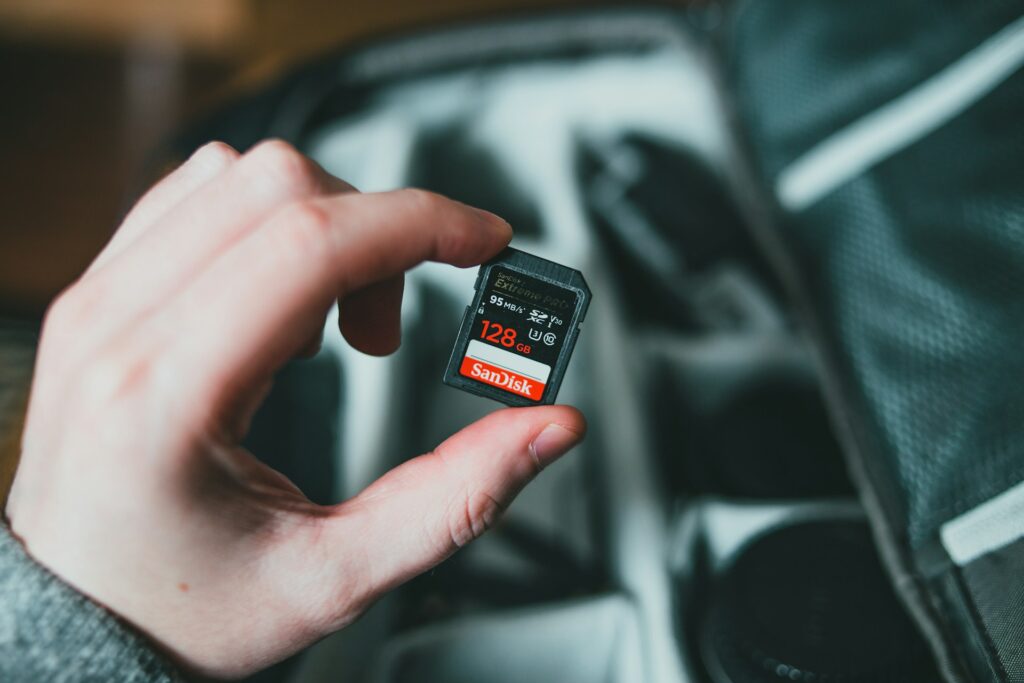
The mobile industry removed the memory card slot from our phones without asking us, and justified it with weak arguments about design, water resistance and internal space. Curiously, thanks to that decision the same industry built a billion dollar business.
Every month we pay without protest to store information we could perfectly well keep on our own device at a far lower cost.
Why do we pay every month for space we used to buy only once?
By: Gabriel E. Levy B.
For younger generations, paying for a cloud service on the Internet to hold their photos and videos is probably normal, part of the household budget their parents have to carry. Yet it does not have to work that way. Keeping information in the cloud can be very useful, but it should be a choice for the user and not an obligation born of a very convenient technological decision, taken at the time by the big manufacturers with technical arguments and a commercial motive underneath.
The iPhone never had a memory card slot. We cannot know for certain whether it was a matter of design, of Steve Jobs and his commercial vision, or a coincidence. The same happened with Google Pixel phones, something that seemed crazy at the time, because you cannot build devices able to capture an unlimited number of photos or videos and then leave people with nowhere to store that material.
The same industry then sold us the solution to a problem it created: paying for remote storage on the Internet to hold what we always kept locally and never needed anyone else to hold for us. That is how a market worth close to 25 billion dollars a year was born, with Apple taking 34% and Google 25%.
Samsung proves this is a business
Apple and Google have always maintained that leaving slots out of their phones is a technological decision. Samsung is a different case, and it proved the choice is commercial rather than technical.
Samsung removed the slot in the 2015 Galaxy S6, brought it back with the S7 in 2016, and eliminated it for good in the S21 series, launched in January 2021.
All three models of that generation arrived without expandable memory, starting at 128 GB, and anyone who filled that capacity was left with the cloud as the only way out.
Manufacturers talked about speed and design. And yet the Galaxy A16, a 199 dollar handset, keeps the slot that the same brand removed from its most expensive models.
The feature survives in the budget range and disappears at the premium end. That asymmetry says a great deal about the business and very little about the engineering.
If it is a technical decision, why can the simplest models have the slot while the most sophisticated ones cannot?
The gap had an owner
Whoever sets the factory capacity wins twice. First they sell the model with the most storage, because with no expansion available it makes sense to pay for the large version from the start. Then they charge the subscription once that storage fills up.
The free tiers have been frozen for more than a decade.
Apple has kept 5 GB free since 2011. Google still offers 15 GB shared across Drive, Gmail and Photos since 2013. Phone cameras, meanwhile, went from 8 megapixels to 4K and 8K video.
The number of people using personal cloud storage grew from 1.1 billion in 2014 to around 2.3 billion today. Apple leads that market with 34% share, followed by Google Drive with 25% and Dropbox with 15%.
The bill we all pay
Apple official price table for Colombia sets 3,900 pesos a month for 50 GB, 12,900 for 200 GB and 44,900 for 2 TB. The middle plan adds up to 154,800 pesos a year and 774,000 over five years. The 2 TB plan reaches 538,800 pesos a year.
Google One starts at 1.99 dollars a month for 100 GB and 2.99 for 200 GB. The company itself reported that it raised its rates in Colombia, Chile, Peru, Mexico and Brazil from February 2025.
The comparison carries an uncomfortable nuance worth acknowledging.
We cannot deny that memory cards stopped getting cheaper under economies of scale, as should have happened over the past decade. Prices are climbing instead: chip manufacturing costs rose more than 100% since 2025, and United States tariffs added between 4% and 6% to the final price.
SanDisk, for instance, launched a 1 TB microSD Express card in August 2026 with a list price of 429 dollars. Even so, a 512 GB Lexar Play Pro sells for 99.99 dollars, and that outlay happens once in a lifetime.
In other words, buying memory for our devices keeps getting more expensive, and that is a reality we cannot argue with, but those payments happen only once, while the subscription never ends.
The cloud solves real problems
It is almost impossible to deny that we are looking at a business built on a lie, yet it is also fair to acknowledge without evasions that the cloud service works very well and helps a great deal.
A phone stolen in Quito or lost on a bus in Buenos Aires does not take the family photos with it if they were backed up to Apple, Google or Dropbox. If the device gets wet, goes missing, is stolen or burns, the memory stays on servers in California, China or Dublin, which keep copies and backups and guarantee that the information is always available, wherever it is accessed from.
Syncing between phone, computer and tablet saves real working time. Sharing an album with the grandparents takes seconds, and drafting shared documents from different parts of the world is now possible.
Nor can we deny that memory cards fail too, and far more often than we imagine: they corrupt, they get lost, and the market is full of counterfeits that advertise capacities that do not exist or that work for a week and then break down.
A 1 TB card selling for less than 40 dollars is very likely a fraud.
All of this deserves a fair conclusion: the cloud is a much better option than local storage. That is not in dispute. The problem appears when usefulness turns into obligation.
Choosing the cloud is one thing. Being left without an alternative inside your own device is another. And when we talk about Latin America, Africa or Central Asia, regions with such limited economic resources, this is no small matter. Forcing a poor family to pay for a service they could do without is unfair.
Dependence has consequences
Whoever stops paying does not lose the service gracefully. Backups halt, photos stop uploading, and files sit in a limbo the company manages on its own schedule.
That lock-in has already reached the courts.
In June 2026 the United Kingdom Competition Appeal Tribunal cleared a class action against Apple over its iCloud service, brought since November 2024 by the consumer organization Which?, on behalf of almost 40 million British users. The claim amounts to 3 billion pounds and the trial is expected in 2028.
The complaint argues that the company imposed technical restrictions on file storage and integrated iCloud with its devices in a way that makes moving to another provider an uphill climb.
The tribunal also rejected, by two votes to one, the company attempt to limit the case to those who paid for a subscription.
No equivalent lawsuit has been filed in Latin America. Competition authorities in the region watch these markets through a borrowed lens, and the debate on personal data portability remains pending on the Latin American regulatory agenda.
Practical ways out remain. Motorola, Xiaomi and Samsung mid-range still offer a slot.
An external drive or a network drive solves home backup with no monthly fee.
In short, the disappearance of the slot was no accident of industrial design. It was a commercial decision that turned a one-off outlay of twenty or a hundred dollars into a perpetual fee charged for as long as we live. The cloud provides a valuable service and deserves to be paid for when we choose it. What is hard to defend is that they took away our ability to decide, and that millions of people in the region now pay every month for something that fitted on a sliver the size of a fingernail.
References
- Apple. (2026). Planes y precios de iCloud+. Soporte técnico de Apple. https://support.apple.com/es-lamr/108047
- Google. (2026). Comprar más espacio de almacenamiento de Google. Ayuda de Google One. https://support.google.com/googleone/answer/2375123
- Schoon, B. (2021). Samsung ditches microSD card support on Galaxy S21. 9to5Google. https://9to5google.com/2021/01/14/samsung-microsd-card-support-galaxy-s21/
- BGR. (2026). When did smartphone brands stop using SD cards. https://www.bgr.com/2126300/when-did-smartphone-brands-stop-using-sd-cards/
- Yahoo Finance. (2026). UK tribunal greenlights $4bn class action over Apple iCloud. https://finance.yahoo.com/technology/articles/uk-tribunal-greenlights-4bn-class-110029100.html
- Tech Insider. (2026). SanDisk 1TB microSD Express card price analysis. https://tech-insider.org/sandisk-1tb-microsd-express-switch-2-price-2026/
- Softjourn. (2026). Cloud computing statistics report. https://softjourn.com/insights/cloud-computing-stats
- Persistence Market Research. (2026). Consumer Cloud Storage Services Market. https://www.persistencemarketresearch.com/market-research/consumer-cloud-storage-services-market.asp