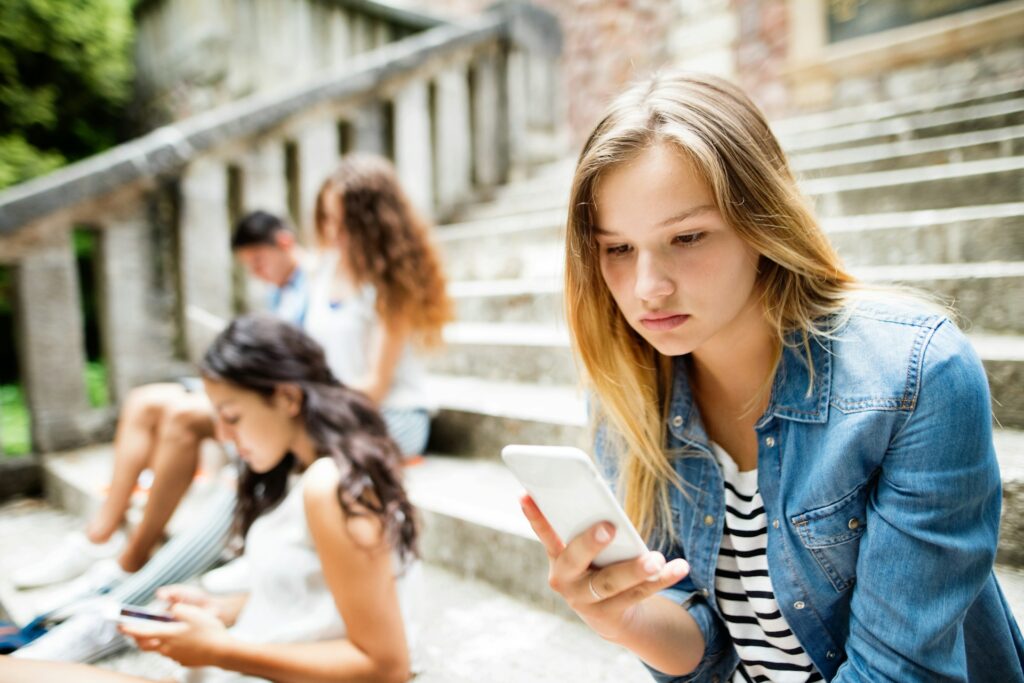
An unprecedented law has just come into force in Australia: children under the age of 16 can no longer have accounts on most social networks. From TikTok to Reddit, platforms are required to delete existing accounts and prevent new ones from being created. The law seeks to protect children’s mental health and reduce digital harm, but raises questions about its effectiveness, legality and unintended consequences.
“This free access can no longer be allowed”: a shift in digital politics
By: Gabriel E. Levy B.
For years, warnings about the effects of social media on children and teens piled up like a slow, but imminent, storm.
Neurodevelopmental experts, child psychiatrists, and mental health organizations began to speak out.
It was no longer a matter of opinions but of evidence. The longitudinal study by Twenge and Campbell (2018) warned that the increase in depression and anxiety in adolescents coincided with the growth in the use of social networks.
Shortly after, Jean Twenge synthesized it in his book iGen, where he exposes how those born after 1995 grew up with less sleep, more anxiety and fewer deep social ties.
In this scenario, Australia took a step that until now no other country had dared to materialize. As of December 10, 2025, the Online Safety Amendment (Social Media Minimum Age) Act 2024 came into force, a law that sets the minimum age for using social networks such as Facebook, TikTok, Instagram, YouTube, Reddit, Twitch, X (ex-Twitter), Threads and other high-impact digital platforms at 16 years old.
More than a symbol, it’s a toothy decision: companies must implement strict age verification controls, and if they don’t, they expose themselves to fines of up to $49.5 million. The eSafety Commissioner, Julie Inman Grant, said that this is “a first step in restoring digital safety to children”.
The law not only aims to limit access, but also to redefine the boundaries between technology and childhood.
“Social media was not designed for children”
The guiding principle of this new legislation can be found in a phrase that is repeated among legislators and advocates of the measure: the internet was never built with children in mind. The objective, according to the Australian government, is not to censor but to regulate the digital environment to which minors are exposed.
From a technical point of view, the law requires designated platforms to apply “reasonable measures” to prevent minors under the age of 16 from accessing or remaining on these services.
Companies will have to use verification systems that may include biometric analysis, behavior-based artificial intelligence or indirect age tests.
Official documents cannot be mandatorily demanded, partly out of respect for privacy, which has generated a technical debate: how do you guarantee compliance without falling into intrusive surveillance?
This is where one of the biggest challenges of the law appears: its applicability. Even the eSafety Commission acknowledges that it will be difficult to prevent teenagers from lying about their age, using VPNs or simply consuming content without registering.
The difference, they say, is symbolic and structural: the “open door by default” is eliminated and the responsibility is transferred to the platforms.
The mental health organization Beyond Blue supports the measure as “a necessary step to protect early emotional development.”
However, he also warns that it is not a magic solution and that digital education must accompany all regulatory intervention.
“They are taking away our voice”
As expected, the implementation of the law did not take long to generate resistance.
On the first day of its operation, hundreds of teens reported that their accounts were closed without warning.
In Melbourne, a 15-year-old girl, known as “Sophie T.”, filed a lawsuit against the state alleging that the law violated her freedom of expression and her right to participate in digital social spaces.
“I have no other way to stay in touch with my LGBTI support group outside of Instagram,” she said in an interview with The Guardian.
It is not an isolated case. Various civil society organizations, such as Human Rights Watch and Digital Rights Watch Australia, have expressed concern about the precedent that this law may set.
They argue that while child protection is legitimate, the mechanism used can backfire.
According to them, the law could push teens onto unregulated platforms or to create underground accounts, without supervision or support from responsible adults.
Danish researcher Thomas Hylland Eriksen, author of Tyranny of the Moment, argues that digital time not only transforms access to information, but also the perception of the self and community.
For teenagers, banning networks can be tantamount to expelling them from the space where much of contemporary social life takes place. The risk is not only technical, but cultural.
In the same vein, the Snapchat platform announced that it will study mechanisms to challenge the law, arguing that its service includes parental control tools and that a total ban could increase the isolation of vulnerable young people. The tension between regulation and access has no simple answers.
“It’s not censorship, it’s care”: the cases that already reveal cracks
Less than a week after the law came into force, the specific cases are already beginning to make visible both their successes and their failures.
In Brisbane, the mother of a 13-year-old boy applauded the move: “My son spent five hours a day watching TikToks, now he rediscovered the yard.” But in Sydney, a high school teacher reported that her students continue to access YouTube and TikTok through shared accounts or without logging in, without losing actual access to content.
A preliminary report from the eSafety Office found that platforms such as Reddit and Twitch had begun to apply more aggressive filters, but others such as X and YouTube maintained significant loopholes.
Some networks limited themselves to asking for a confirmation of age without effective verification, which raises doubts about the real capacity of the government to supervise.
Questions also arise about the fairness of the application.
In rural communities or those with less digital literacy, verification mechanisms can become technical barriers that affect even those over 16 years of age.
Access to digital evasion tools, such as VPNs or fake accounts, is also not evenly distributed, which can lead to an unexpected digital divide.
One case that generated media attention was that of two brothers in Perth, aged 14 and 16, whose joint YouTube account was shut down.
The eldest tried to prove his age with a photo of the school document, but the platform rejected it. The family denounced the situation as an “algorithmic overzeal” and called for a manual review.
The first online tutorials with “tricks to evade Australian law” have also appeared, which could generate a new informal market for fake digital identities.
In conclusion
Australia has just implemented an unprecedented measure by banning access to social networks for children under 16 years of age, sparking a deep debate on mental health, privacy, digital rights and regulatory effectiveness.
While it aims to protect children from the risks of the digital world, the law also faces ethical and technical challenges that strain the relationship between state control and youth autonomy.
Its evolution will set a precedent that other countries will follow closely.
References
- Twenge, J. M., & Campbell, W. K. (2018). The Narcissism Epidemic: Living in the Age of Entitlement. Atria Books.
- Twenge, J. M. (2017). iGen: Why Today’s Super-Connected Kids Are Growing Up Less Rebellious, More Tolerant, Less Happy. Atria Books.
- Eriksen, T. H. (2001). Tyranny of the Moment: Fast and Slow Time in the Information Age. Pluto Press.
- eSafety Commissioner (2025). Social Media Age Restrictions
- UNICEF Australia (2025). Social Media Ban Explainer
- BBC, The Guardian, Reuters, ABC, CNN (2025). Coverage of the Online Safety Amendment (Social Media Minimum Age) Act 2024.