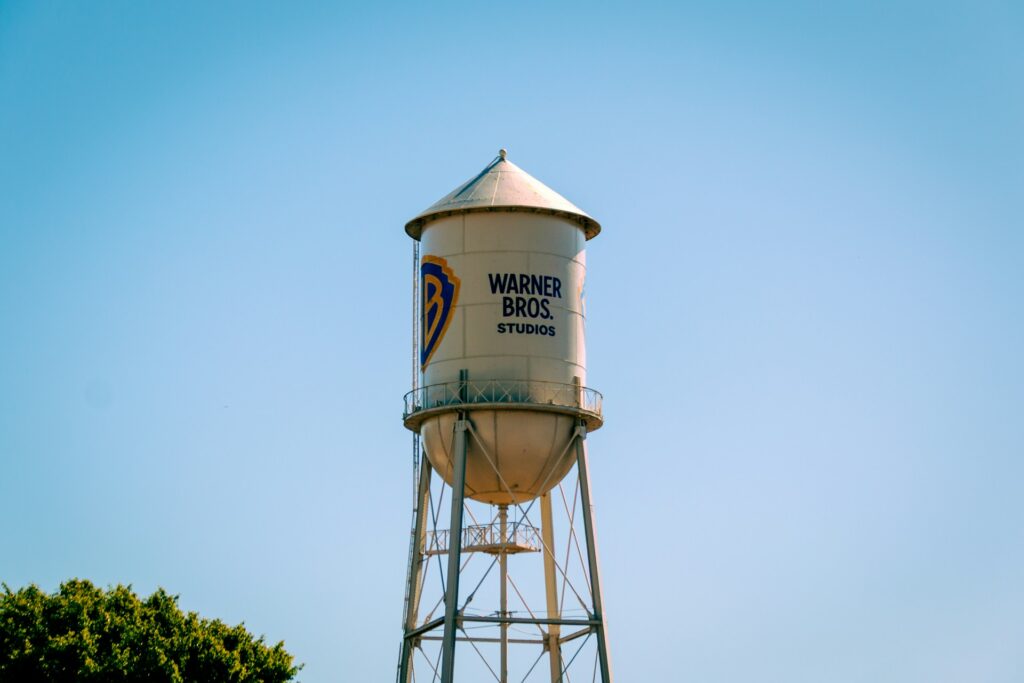
Netflix’s recent $82.7 billion purchase of Warner Bros. Discovery is more than just a merger of companies: it represents a profound reconfiguration of the global audiovisual ecosystem.
While Netflix celebrates the closing of a historic operation that places it at the forefront of global entertainment, the rest of the sector, users, creators, competitors and even nations, seems to have been left in a losing position.
“The history of Hollywood is sold to the highest bidder”
By: Gabriel E. Levy B.
In June 2025, Warner Bros. Discovery announced the division of its assets, paving the way for one of the most coveted auctions in the industry. Paramount, Comcast, Apple and Amazon entered the bidding.
But it was Netflix that, with an aggressive offer of $30 per share and a total package that includes debt, reached $82.7 billion, imposing itself as the final buyer.
This move marks a turning point. The company acquires not only Burbank’s physical studios, but more than a century of intellectual property: Warner’s franchises, the HBO brand and its prestige, as well as thousands of hours of content that are now under the control of a single platform.
Netflix doesn’t simply buy content; it buys history, memory and cultural prestige.
The acquisition is reminiscent of what was anticipated by MIT academic William Uricchio, when he warned that control of the media no longer depends so much on creation as on the distribution and accumulation of catalogs.
In his vision, new cultural empires are not built with ideas, but with licenses. And Netflix has just pulled off the biggest blow of all.
“Concentration is the new name of the game”
For more than a decade, the entertainment market experienced an explosion of offers. Streaming platforms multiplied: HBO Max, Disney+, Apple TV+, Paramount+, Peacock, Amazon Prime Video and many others promised to fragment the monopoly that Netflix had built in advance.
That diversity, however, proved unsustainable. Rising production costs, licensing wars, and a finite attention economy led to inevitable consolidation. The purchase of Warner Bros. Discovery is the latest chapter in that cycle.
Netflix, which until recently was seen as a threat to traditional studios, is now becoming a hegemonic player.
It controls distribution, imposes technological standards, decides on formats and production rhythms.
What was once an open field for innovation and diversity is now reduced to a single-platform logic, where the algorithm determines which stories deserve to exist.
For economist and cultural critic Jonathan Taplin, author of Move Fast and Break Things, this trend is not new.
Big tech, as they gain power, tend to eliminate any form of dissent or competition through strategic purchases.
Taplin warns that the result is a domesticated creative ecosystem, where narrative risk is replaced by profitable repetition.
And with Warner in the hands of Netflix, that model reaches a new dimension.
In addition, the political context favors this type of movement.
With weakened regulatory bodies and a techno-liberal vision of economic growth, mergers are seen as synonymous with efficiency and global competitiveness.
But what is presented as efficiency is, in reality, a new form of narrative monopoly.
“More Netflix means less freedom for everyone”
Few seem to notice the cultural magnitude of what is at stake. The purchase of Warner is not simply the merger of two companies; it is the consolidation of a global narrative regime where a single platform, Netflix, will have the power to decide what is watched, how it is seen and under what conditions it is produced.
Users lose, even if they don’t notice it in the short term. Less competition means fewer choices, less diversity of subscription models, and ultimately, higher prices.
This has already been demonstrated by market studies such as that of the USC Annenberg School for Communication, which concluded that media concentration drastically reduces cultural and ethnic representation in audiovisual products.
Independent producers are also trapped. Before, they could trade with multiple platforms. Today, the figure of Netflix as an all-powerful buyer changes the rules of the game.
The recommendation algorithm, opaque and commercially oriented, imposes rhythms and formats, making invisible everything that does not fit into its metrics. Risky, experimental or simply divergent productions disappear from the global grid.
For peripheral countries, the impact is even greater. Cultural sovereignty, understood as the ability to tell and distribute one’s own stories, is diluted in the face of the domination of an actor who imposes languages, aesthetics and structures.
Local content, even if it is produced, will be produced under external criteria, with a global logic that understands little about contexts or identities.
This phenomenon has a precedent: the effect of the globalization of Hollywood in the 80s and 90s, when national cinematographies were cornered. But now power is even more centralized, more automated, and insidious. And all under the wrap of a friendly interface and a monthly subscription.
“Amazon and Apple are watching from afar”
After this acquisition, the entertainment map is dangerously unbalanced. Amazon and Apple still have financial muscle, but content is not their priority.
For them, Prime Video and Apple TV+ are extensions of their commercial ecosystem, not centers of narrative power. That leaves Netflix as the only purely audiovisual actor with expansive ambitions.
Disney, which seemed unbeatable a few years ago, is facing a crisis of identity and leadership.
Its commitment to franchises such as Marvel or Star Wars has suffered obvious attrition, and its streaming strategy has had mixed results. Paramount, for its part, lacks sufficient financial backing to face a long-term war. The pieces are in place: Netflix is the only player with a clear strategy, a robust infrastructure and, now, with the historical prestige that Warner gives it.
Examples abound. In India, where local cinema had a remarkable vitality, Netflix imposed new standards of format and content, displacing traditional production companies.
In Latin America, platforms such as Claro Video, Movistar Play or Blim could not compete with the production and marketing power of Netflix.
Even in Europe, initiatives such as Arte or Filmin must constantly negotiate their existence in the face of the rules imposed by the giant.
And it’s not just about money. It’s a matter of visibility. In a world where being on the “home” of Netflix defines success, those who do not achieve that place simply disappear from the cultural map.
In conclusion, Netflix’s purchase of Warner Bros. Discovery does not represent a victory for the industry, but a silent defeat for its diversity, its creativity, and its balance. With less competition, less narrative plurality and more concentration of power, the audiovisual market is entering a new era: that of the empire of the algorithm. And in that empire, only Netflix wins.
References:
- Uricchio, W. (2011). Media Cultures: Theories and Approaches. Polity Press.
- Taplin, J. (2017). Move Fast and Break Things: How Facebook, Google, and Amazon Cornered Culture and Undermined Democracy. Little, Brown and Company.
- USC Annenberg School for Communication (2022). Inclusion in the Director’s Chair Report.