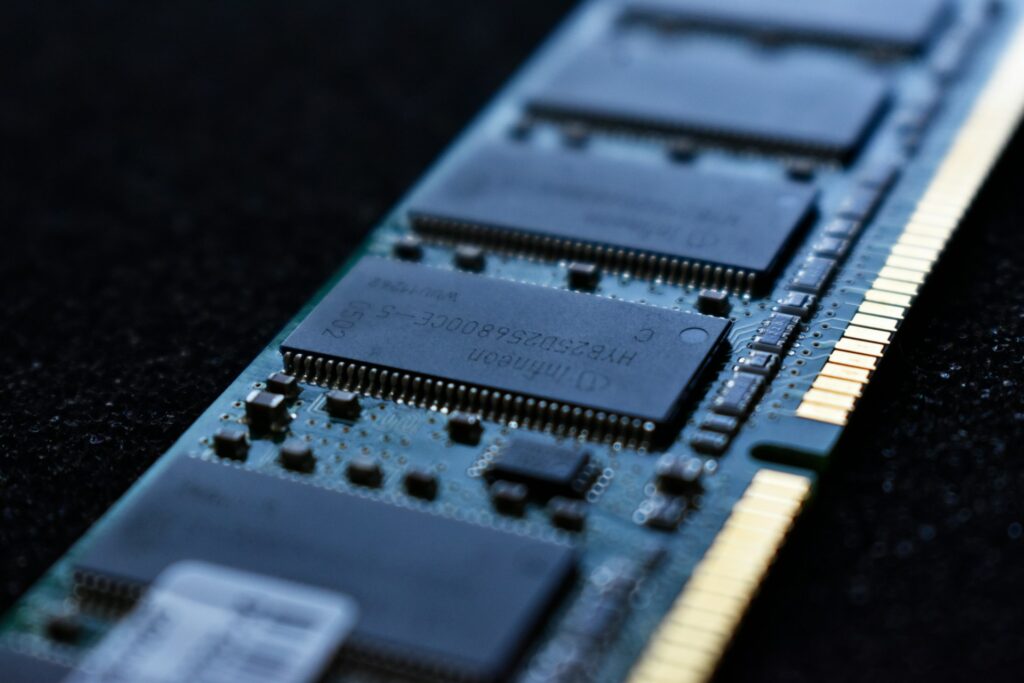

The artificial intelligence revolution has a cost that few calculated: it is leaving the world without RAM. The three manufacturers that control 95% of the world’s production, Samsung, SK Hynix and Micron, have turned their plants towards a high-margin product called HBM (High Bandwidth Memory), the specialized memory that keeps AI data centers alive.
The result is a shortage already being felt in tech stores, on car assembly lines, and in the budgets of thousands of companies.
Conventional RAM prices rose as much as 172% in 2025, and those who follow the market closely see no relief before 2027.
Why AI Needs So Much Memory
By: Gabriel E Levy B
To understand the crisis, you have to know how artificial intelligence works from the inside. Large language models, such as those behind ChatGPT or voice assistants, store billions of pieces of data that must constantly move between memory and processors.
That data movement, rather than the computation itself, is what consumes the most time and limits the speed of the system.
HBM memory was designed to solve that problem. Instead of a conventional flat chip, it stacks several layers of memory vertically, connected by thousands of simultaneous channels.
The result is a data transfer rate of 8 terabytes per second, compared to 100 gigabytes per second for the DDR5 memory used by a normal computer.
It is, in practical terms, eighty times faster.
The consumption figures say the rest. An NVIDIA H100 chip carries 80 GB of HBM3. Its successor, the B200, incorporates 192 GB. An AI server with eight B200 chips consumes 1.44 terabytes of HBM on its graphics cards alone, while a conventional office server uses zero.
The aggravating factor is that producing one gigabyte of HBM requires four times more manufacturing capacity than producing one gigabyte of normal DDR5. Every silicon wafer that goes to AI is a wafer that doesn’t go to a student’s laptop or someone’s phone in Bogotá or Mexico City.
Investment in AI infrastructure by big tech companies, Amazon, Microsoft, Google, Meta and Oracle among others, will be around 600,000 million dollars by 2026, and three-quarters of that money goes to data centers.
HBM’s market went from $17 billion in 2024 to about $34 billion in 2025.
All production is already committed well into that year.
Micron’s own CEO admitted in March 2026 that its most important customers only receive between half and two-thirds of the memory they order.
Three manufacturers on the edge
SK Hynix was the first and strongest bet on HBM, and today it leads the market with between 53% and 62% of the global share.
It supplies about 90% of the memory that NVIDIA uses. That advantage allowed it to overtake Samsung as the world’s largest memory chip seller by 2025, something that had never happened before.
Its annual revenue for that year reached $67.9 billion, with an operating margin of 49%.
It has committed an investment of more than 107,000 million euros in expansion, but the first of its new plants will not start up until 2027.
Samsung had a difficult period. For a year and a half, it failed to pass NVIDIA’s qualification tests for its HBM3e memory, leaving it with just 17% of the HBM market by mid-2025. It finally passed in September of that year and since then it has focused all its resources on the next generation, called HBM4, where according to industry reports it obtained the best marks in speed and energy efficiency. By 2026, it plans to triple its HBM sales and expand its manufacturing capacity by half.
Micron, the U.S. company that completes the trio, went from having between 4% and 7% of the HBM market in 2024 to 21% in 2025. The most telling sign of where the sector is going came at the beginning of 2026, when it canceled its consumer memory brand, Crucial, to free up productive capacity and allocate it to AI customers. It has promised to invest $200 billion in facilities in the United States, although those factories will not produce on a full scale before 2027 or 2028.
Consumers pay the bill
The most direct consequence for the ordinary citizen is the price. The 32GB DDR5 memory kits went from around $80 to over $430 throughout 2025. DDR4, which was already considered a mature and cheap technology, rose between 100% and 150% because, with shortages, even the oldest models become scarce. Distributors went from having 31 weeks of inventory on hand to just 8, and new orders are quoted with more than a year of waiting.
The effect is transferred to the final products. Memory now accounts for 35% of a computer’s material cost, up from 15% to 18%. The big PC manufacturers announced price increases of between 15% and 20%.
Market analyses predict that computer sales will fall between 9% and 11% in 2026, and smartphone sales between 7% and 9%.
Budget phones, those that cost less than $100 and are the best-sellers in emerging markets, could see a 31% drop in global shipments.
The auto industry is also in trouble. Modern vehicles increasingly carry memory chips for their assisted driving systems, infotainment screens and sensors. But the automotive sector accounts for less than 10% of the global chip market and has no power to compete with purchase orders from Meta or Google. Several manufacturers estimate the cost overruns they will face in 2026 at billions of dollars.
Impact on Latin America
Latin America will receive the blow with very few defenses. The region does not produce a single memory chip, is totally dependent on Asian imports and has minimal electronic manufacturing capacity. That leaves her exposed on several fronts at the same time.
The most immediate is that of phone prices. In Colombia, Mexico, Peru, Bolivia and most Latin American countries, between 60% and 70% of smartphone sales correspond to models that cost less than 200 dollars. It is the segment that is going to suffer the most, because it is the one that depends the most on cheap and abundant memory. With the projected 31% drop in shipments of such devices, millions of people are going to have a harder time renewing their phone or getting their first smartphone. In a region where the mobile phone is the main, and often the only, gateway to the internet, that is not a minor problem.
The second impact hits companies and public entities. SMEs, universities, hospitals, and governments that need to purchase or expand computer equipment will find higher prices and longer delivery times. In countries where public tenders are planned a year or more in advance, the increase can make budget items obsolete before they are executed.
The third effect comes through digital services. Data centers in Brazil, Mexico and Chile, which concentrate most of the cloud infrastructure in the region, need to renew their servers to absorb the growth of digital traffic. With more expensive and scarcer memory, their operating costs go up, and those costs sooner or later reach the fees that companies and users pay for online storage, SaaS platforms, and computing services.
There is also a quieter threat. U.S. export restrictions have left China without access to the most advanced memory chips, which could lead Chinese manufacturers to dump older-generation memory in Latin American markets at artificially low prices. That could displace higher-quality options and deepen the region’s technological dependence on suppliers over whom it has no influence.
Geopolitics complicates things
Tensions between Washington and Beijing have added another layer of uncertainty to the market. U.S. export restrictions block Chinese access to the most advanced HBM memory. The leading Chinese DRAM manufacturer is working on its own version of HBM with mass production planned for 2026, but the technological gap with SK Hynix or Micron is estimated at between six and eight years, and without access to the latest generation lithography equipment, this lag is very difficult to shorten.
China has responded by restricting exports of gallium, germanium and rare earths, materials that are inputs needed to make semiconductors. The result is that the global memory market today operates under a logic that mixes commercial competition with geopolitical rivalry, and that combination is not good for price stability or for countries that, like Latin America, are at the receiving end of the chain.
It could improve the situation
There are factors that can alleviate the crisis, although none will act immediately. On the technological side, the new HBM generation is already in initial production, with twice the bandwidth of the previous one. Interconnection standards are also being developed that would allow large blocks of memory to be shared between servers, reducing pressure on production. Some software techniques can reduce the memory consumption of AI models by 60% to 80%, although the historical trend is that models always grow faster than savings.
On the supply side, the announced investments are on a scale unprecedented in the history of the sector, but building a semiconductor factory takes between three and five years. The plants that SK Hynix, Samsung and Micron are building right now in Korea, the United States and Japan are not going to produce in volume before 2027 or 2028. Until then, shortages and high prices will remain the norm.
Conclusions
This crisis is not an accident or a temporary turbulence. It is the logical consequence of a technological change that came much faster than the industry could assimilate. In less than three years, artificial intelligence went from being an academic experiment to becoming the number one investment priority of the largest companies on the planet. The memory supply chain wasn’t prepared for that leap, and now everyone is paying the price.
What’s more telling is that manufacturers have no incentive to reverse course. Producing HBM is exponentially more cost-effective than producing DDR5 for an ordinary consumer. As long as that equation doesn’t change, silicon will go where the money is, which today is in AI data centers, not in a college student’s laptop.
For Latin America, the crisis has an additional dimension that deserves attention. The region has been in the role of consumer of technology that others design, manufacture and price for decades. This shortage once again demonstrates the cost of that position. Having no link of your own in the semiconductor chain means you have no margin to protect yourself when the global market becomes disrupted.
Technological sovereignty is not a concept reserved for speeches. It is a concrete lever for economic development. Countries that in the coming years manage to build capacities in chip design, advanced packaging or critical materials will have a different position in the face of crises like this. Those that don’t will still depend on factories in Seoul or Idaho to decide how much memory they get.
REFERENCES
- DRAM and HBM market reports, 2025-2026.
- Global Memory Shortage Crisis: Market Analysis and Impact on Smartphone and PC Markets in 2026.
- Micron Technology. Fiscal Q1 2026 Earnings Call Prepared Remarks.
- SK Hynix. 2026 Market Outlook: HBM-led Memory Supercycle.
- Memory crisis latest: What we learned from the world’s top producers, March 2026.
- Tom’s Hardware. Here’s why HBM is coming for your PC’s RAM.
- Memory Shortages To Last Till At Least Q4 2027.
- Global smartphone shipments to fall 7% in 2026 amid memory constraints.
BISI, Bloomsbury Intelligence and Security Institute. Global RAM Shortage and Price Hikes: Causes, Consequences, and Outlook.
- Yole Group. Memory market surges beyond expectations: almost $200 billion in 2025 driven by HBM and AI.