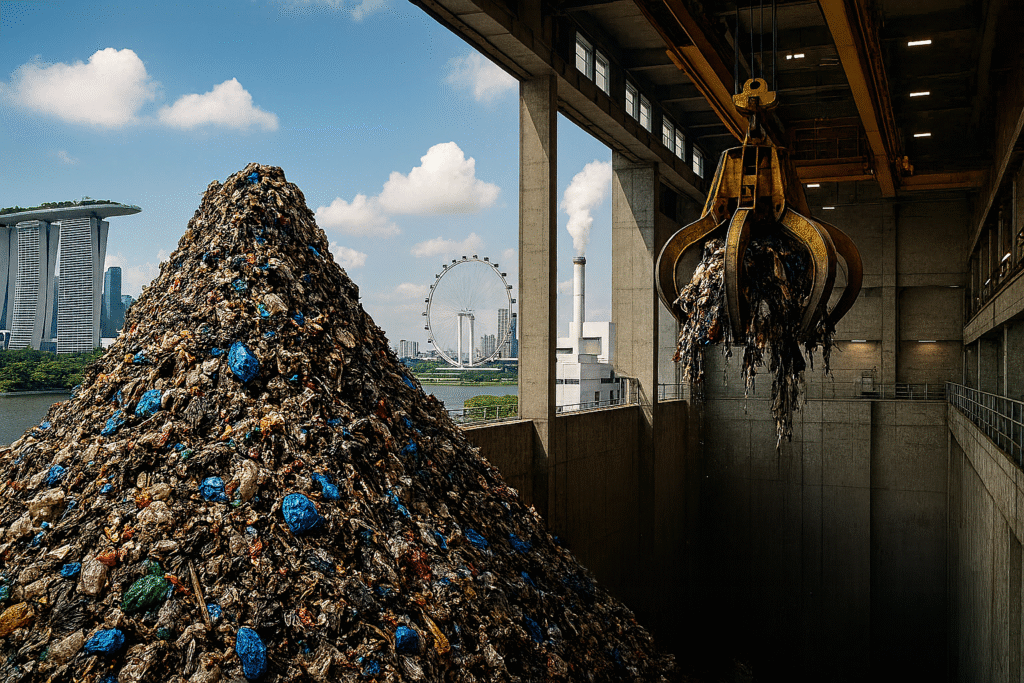
In Singapore, garbage does not end up in a landfill; it is transformed into energy that illuminates homes and offices.
Every day, thousands of tonnes of waste travel by truck to plants where fire converts it into steam and, through turbines, into electricity.
On an island with no space to waste, the country designed a management model that not only reduces the mountain of waste, but also feeds its energy grid.
Fire as an urban strategy
By: Gabriel E. Levy B.
The history of waste management in Singapore is marked by necessity.
In the 1970s, the city-state faced a dilemma: accelerated urban growth multiplied garbage while the territory available to dump it was exhausted.
The government then adopted incineration as the main way to handle waste.
In 1979 it opened its first plant, Ulu Pandan, which processed 1,200 tonnes per day.
The commitment was consolidated with the construction of larger facilities such as Tuas Incineration Plant (1986) and Keppel Seghers Tuas Waste-to-Energy Plant (2009), the latter designed with more efficient gas filtration and heat recovery systems.
According to the National Environment Agency (NEA), currently 90% of waste is incinerated, reducing its volume by 90% and generating around 3% of the electricity consumed in the country.
Environmental economist Nicholas A. Ashford (MIT) noted that incineration systems are, in dense urban contexts, “a trade-off between energy sustainability and spatial constraints” (Ashford and Caldart, Technology, Law, and the Working Environment, 2008).
In Singapore, that commitment became state policy.
Garbage as a resource
Converting waste into electricity is not only explained by technological innovation, but also by a cultural and political framework.
Singapore designed a narrative of “garbage as a resource” that permeated their daily lives.
The city-state produces more than 7,000 tons of waste per day.
With no space for landfills, he opted for a double strategy: recycle as much as possible and incinerate the rest. Two products arise from this combustion: energy and ashes.
The former supplies up to 300,000 homes.
The latter, which represent 10-15% of the original weight, end at Pulau Semakau, an artificial island built in 1999 8 kilometers from the coast. There, the ashes are deposited in sealed cells that prevent leaks and, at the same time, the space functions as a nature reserve with mangroves and migratory birds.
This approach reflects what Zygmunt Bauman called “liquid modernity”: societies that do not produce less waste, but reorganize it to maintain consumption without visible friction (Life of Consumption, 2007).
In Singapore, incineration works like that reorganization that hides garbage from the eyes of citizens, transforming it into electric light or a green island.
In addition, the system is part of the Zero Waste Masterplan (2019) policy, which projects to reduce the amount of waste sent to Semakau by 30% by 2030. The strategy includes recycling incentives, school programs and mandatory waste sorting in public and private buildings.
Garbage has become an axis of national identity: a country that shows how scarcity can be turned into an opportunity.
The Paradox of Smoke
However, incineration raises questions. Although current systems comply with international emissions standards, critics point out that burning waste releases carbon dioxide and polluting particles. While Singapore installed state-of-the-art filters, reliance on incineration makes it difficult to move towards a truly circular economy.
The International Solid Waste Association (ISWA) warns that energy recovery can be a trap: by guaranteeing electricity from waste, an incentive is created to maintain high volumes of waste. In other words, the more waste generated, the more energy is produced, perpetuating the cycle of consumption.
In addition, the ashes, although stored in Semakau, are still an environmental liability.
Studies by Nanyang Technological University showed that they contain heavy metals that could leak in the future if not managed with extreme care.
Singapore managed to show an efficient model, but faces the paradox of sustaining it in an era that demands less incineration and more reduction at source.
The National Environment Agency itself recognizes that the real challenge is not to burn better, but to generate less garbage.
3% of the electricity produced seems like an achievement, but it’s also a reminder: the energy that lights living rooms is born from an as-yet-unsolved problem.
From Semakau to Tuas Nexus
Specific cases illustrate the evolution of this model.
Pulau Semakau, opened in 1999, became a global landmark: the world’s only marine landfill designed as a nature reserve.
Its duality – ash deposit and bird sanctuary – symbolises Singapore’s ability to reinvent waste in landscape.
Another example is the Tuas Nexus, a complex inaugurated in 2025 that integrates an incineration plant with a wastewater treatment plant.
The heat from burning garbage is reused for water treatment processes, and the biogas generated in the wastewater fuels energy production.
This synergy aims to increase efficiency and further reduce emissions.
On a day-to-day basis, the trucks that transport the 3,600 tonnes of rubbish that are incinerated daily are the visible face of the system.
In neighborhoods such as Tampines or Jurong, waste travels from transfer stations to plants in Tuas, Senoko or Keppel Seghers.
Precise logistics keep machinery in motion that cannot be stopped: if the garbage accumulates, the city collapses.
Other countries are watching closely. Japan and Sweden replicated similar models, although with greater emphasis on recycling.
In conclusion, Singapore converted garbage into electricity and built a management model admired and debated around the world. Its incineration system reduces the volume of waste, generates energy and transforms waste into landscape, but it also faces criticism for its dependence on burning and the difficulty of moving towards a lower consumption scheme.
The island that made fire an urban tool continues to burn between efficiency and paradox.
References
- Ashford, Nicholas A. and Caldart, Charles C. Technology, Law, and the Working Environment. MIT Press, 2008.
- Bauman, Zygmunt. Consumer life. Fondo de Cultura Económica, 2007.
- National Environment Agency (NEA), Singapore.
- We are Positive Impact (2025), “Singapore transforms its garbage into electricity”.
- El Español (2025), “The city without landfills”.